

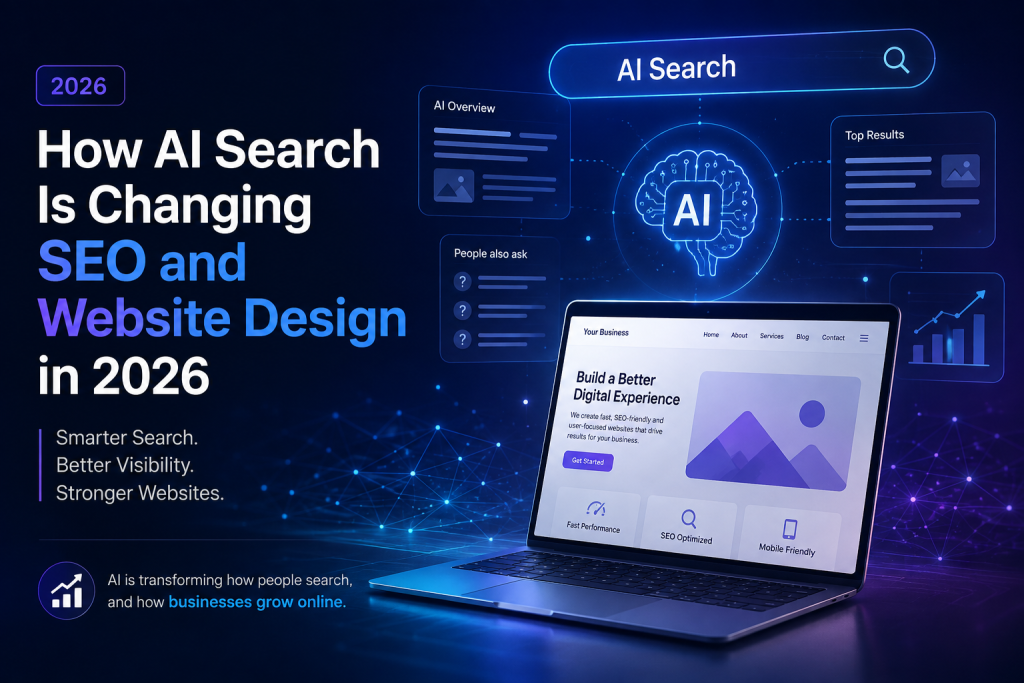
For most of the last two decades, the rules of search were simple enough to explain in a sentence: rank on page one, earn the click, bring the visitor home. That equation no longer holds. Across Google, Bing, and a growing field of AI-native tools, a rising share of queries are now answered before a user ever reaches a website — synthesized, summarized and delivered in a few conversational sentences. For business owners who spent years learning to play by the old rules, the shift can feel disorienting. But it is not the end of search visibility. It is a redefinition of what visibility means, and it is reshaping two disciplines that used to sit in separate departments: SEO and website design.
The End of the Ten Blue Links
The search results page that defined the internet for a generation — ten ranked links, a scroll, a click — is steadily giving way to something more conversational. AI-generated overviews now sit above traditional results for a large share of searches, drawing directly from web content to construct an answer rather than simply pointing to it. Industry researchers tracking this shift report that click-through rates to the top-ranking result have fallen meaningfully as a result, even as overall search volume keeps climbing.
That distinction matters. Fewer clicks do not mean less searching. It means the moment where a brand earns attention has moved earlier in the process — into the answer itself, not just the page beneath it. A business that once measured success by its position on a results page now has to think about something harder to quantify: whether it is the source an AI system chooses to cite, summarize or recommend at all.
Why Structure Now Matters More Than Style
This is where website design and SEO, once treated as separate line items, have effectively merged. AI systems don’t browse a site the way a person does. They parse it — pulling out discrete, well-labeled chunks of information: a clear heading, a direct answer, a defined list, a structured product spec. A beautifully designed page that buries its key information in vague paragraphs or decorative flourishes is easy for a human to admire and hard for a machine to use.
That has real consequences for how a site should be built in 2026. Clean information hierarchy, descriptive headings, fast load times, and semantic HTML aren’t nice-to-haves anymore; they are the mechanisms by which a brand becomes legible to the systems now doing a large share of the world’s information gathering. This is a large part of why website design has become inseparable from search strategy rather than something that happens after it. A site can be visually striking and still be functionally invisible to an AI system if its underlying structure doesn’t give that system anything clean to extract.
Brand Signals Become the New Backlinks
For years, the currency of SEO was the backlink — one site vouching for another. That currency hasn’t disappeared, but it now shares the stage with something broader: consistent, verifiable brand presence across the web. AI systems tend to favor sources that show up again and again, in trustworthy contexts, with clear authorship and a track record. Reviews, press mentions, expert bylines, and consistent business information across directories all feed into a brand’s standing in ways that are hard to fake and slow to build.
For smaller companies, this raises the stakes on decisions that used to feel secondary — like which web design company they hire to build the foundation their content sits on. A site with clean technical bones, accurate structured data, and a coherent brand story across every page gives AI systems and human visitors more reasons to trust what they find.
What This Means for Small and Mid-Sized Businesses
None of this requires an enterprise budget. It requires the right priorities. A capable website design company in 2026 isn’t necessarily the one offering the flashiest animation or the largest template library — it’s the one that understands how a site needs to be built to perform in an AI-influenced search landscape: fast, structured, accessible, and genuinely informative.
That is also good news for businesses watching their budgets closely. Affordable web design doesn’t have to mean a lesser version of good SEO practice. Many of the fundamentals that matter most to AI search — clear headings, honest content, sensible site structure, accurate metadata — cost far less to implement well than they do to fix later. A thoughtful, right-sized approach to website design services often outperforms an expensive site that was never built with structure or intent in mind.
The businesses that will do well in this environment are the ones that treat their site not as a static brochure but as a living, structured source of information — one built by a website design company that understands both the visual and technical sides of the job, and updated often enough that it stays worth citing.
How Broadway Infotech Is Approaching 2026
At Broadway Infotech, we’ve spent the past year rebuilding the way we think about both disciplines. Every new build now starts with information architecture, not templates — a site’s structure is planned before a single visual decision is made. Our SEO recommendations increasingly cover things that used to sit outside the SEO conversation entirely: schema markup, page speed, author transparency, and content that answers a real question in the first two sentences instead of the last two paragraphs.
We don’t think of this as a trend to react to. It’s a more honest version of what good web design services and good SEO were always supposed to do: make it easy for the right audience — human or otherwise — to find, understand and trust what a business has to offer. That’s the standard we’re building to, for every client whose site we touch this year.
Have questions about how your website is performing in AI search results? The Broadway Infotech team is happy to take a look.